-->
Showing posts with label ee_cdw4. Show all posts

Chapter 4: Experimental Analysis of Recycled CDW Materials

4.2. COMPRESSIVE STRENGTH TESTING OF CEMENT MORTAR
     The compressive strength test of the cement mortar is done for the purpose of testing the quality of the recycled fine aggregates (less than 1.18mm size) which is used in place of the natural sand. Indirectly our purpose is to test the quality if recycled fine aggregates. As per IS: 4031 (Part 6) and IS: 4031 (Part 7).


APPARATUS: - Compression testing machine, cube mould of size 7.06cmx7.06cm x7.06cm, temping rod, vibrator, others

PREPARTAION OF THE CUBE SPECECIMEN: - The preparation of the cube specimens have been done as per IS code.

SPECIMEN: - 10 cubes of 7.06cm x 7.06cm x 7.06cm in which cube 01-05 made of mix ratio 1:3 and cube 06-10 made of mix ratio 1:6

HAND MIXING 
a) Mix the cement and fine aggregate on a water tight none-absorbent platform until the mixture is thoroughly blended and is of uniform color.
b) The quantity of water shall be (p/4+3) % of combined weight of cement and fine aggregates where, p is the % of water required to produce a paste of standard consistency determined earlier. Add water and mix it until the cement mortar appears to be homogeneous and of the desired consistency.

SAMPLING 
a) Clean the mounds and apply oil 
b) Fill the cement mortar mix in three layers 
c) Compact each layer with not less than 20 strokes per layer using a tamping rod 
d) Level the top surface and smoothen it with a trowel.

CURING 
The test specimens are stored in moist air for 24hours and after this period the specimens are marked and removed from the molds and kept submerged in clear fresh water until taken out prior to test.

PROCEDURE 
a) Remove the specimen from water after specified curing time and wipe out excess water from the surface.
b) The dimension of the cube should be checked.
c) Clean the bearing surface of the testing machine. 
d) Place the specimen in the machine in such a manner that the load shall be applied to the opposite sides of the cube cast. 
e) Align the specimen centrally on the base plate of the machine. 
f) Rotate the movable portion gently by hand so that it touches the top surface of the specimen. 
g) Apply the load gradually without shock and continuously at the rate of 350kg/cm2/minute till the specimen fails. 
h) Record the maximum load for the further calculation of the compressive strength.

CALCULATIONS
Size of the cube =7.06cm x 7.06cm x 7.06cm 
Weight of the Specimen (Kg) = W Kg Area of the specimen = approx. 50cm2 Compressive strength (fck) at 7 days or 28 days = Load/Cross Section Area of cube (N/mm2)

RESULT
Compressive strength at 7 days = 6.0 N/mm2 (average) Compressive strength at 28 days = 9.0 N/mm2 (average)
Note: - For ordinary Portland cement 43 grade, the compressive strength at 3 days, 7 days and 28 days curing shall not be less than 23 MPa, 33 MPa and 43 MPa respectively.

CONCLUSION OF THE TEST
The ordinary Portland cement stands on their strength, but the recycled fine aggregates used in place of the natural sand could not stand on their strength. The binding between the recycled fine aggregates was very weak and hence it could not carry appropriate load during testing in the compression machine. Hence, the result were not satisfactory. The recycled fine aggregates cannot be used in cement mortar and plaster.
Chapter 4: Experimental Analysis of Recycled CDW Materials

4.1. INTRODUCTION
The experimental investigations have been done to check the qualities of the recycled materials from the construction and demolition waste. The Chapter contains the experimental results of the recycled materials (Recycled Coarse Aggregates & Recycled Fine Aggregates) and of some products made by these recycled materials (Different Concrete blocks). Also the comparison of the characteristics of the recycled materials and that of standard materials have been included for the suitability of the Recycled materials in Real Environment/Construction Industries.
The following laboratory tests have been done on the different materials containing recycled aggregates: -
a) Compressive Strength test of the eco-concrete
b) Compressive Strength test of the cement mortar cubes
c) Compressive Strength test of the Concrete Bricks
d) Laboratory Tests on the Recycled Coarse Aggregates
    i. Specific Gravity Test and Water Absorption Test
    ii. Aggregate Impact Test
    iii. Bulk Density, Fineness Modulus Test (FM)
On the basis of the results obtained from laboratory test. It has been decided that where it can be used in construction work. Use of the all the recycled materials have been explained in the next chapter.

4.2. Compressive Strength Testing of Eco-Concrete
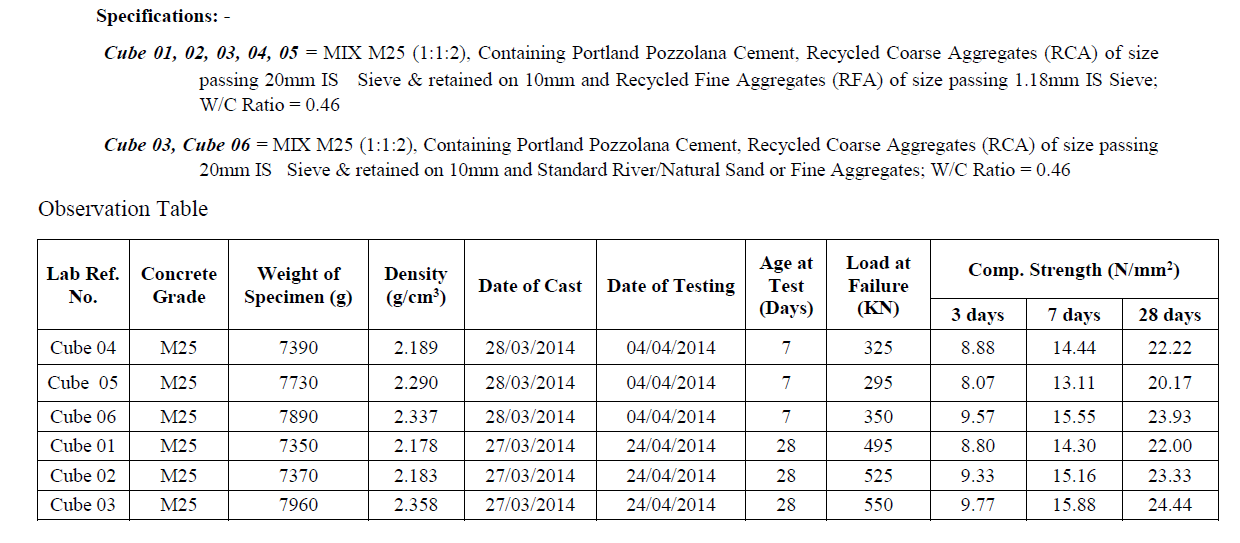
Out of many test applied to the concrete, this is the utmost important which gives an idea about all the characteristics of concrete. By this single test one judge that whether Concreting has been done properly or not. The concrete cube size used under this project was 15cm x 15cm x 15cm as we have used recycled coarse aggregates of the size 10mm-20mm. These specimens are tested by compression testing machine after 7 days curing or 28 days curing. Load should be applied gradually at the rate of 140 kg/cm2 per minute till the Specimens fails. Load at the failure divided by area of specimen gives the compressive strength of concrete. (As per IS: 516)

APPARATUS: - Compression testing machine, cube mould of size 15cmx15cm x15cm, temping rod, vibrator, others.

PREPARATION OF CUBE SPECIMENS: - The proportion and material for making these test specimens have been done as per code IS: 516.

SPECIMEN: - 6 cubes of 15 cm size Mix. M25 

HAND MIXING 
a) Mix the cement and fine aggregate on a water tight none-absorbent platform until the mixture is thoroughly blended and is of uniform color 
b) Add the coarse aggregate and mix with cement and fine aggregate until the coarse aggregate is uniformly distributed throughout the batch 
c) Add water and mix it until the concrete appears to be homogeneous and of the desired consistency. 

SAMPLING 
a) Clean the mounds and apply oil 
b) Fill the concrete in the molds in layers approximately 5cm thick 
c) Compact each layer with not less than 35strokes per layer using a tamping rod (steel bar 16mm diameter and 60cm long, bullet pointed at lower end.
d) Level the top surface and smoothen it with a trowel. CURING The test specimens are stored in moist air for 24hours and after this period the specimens are marked and removed from the molds and kept submerged in clear fresh water until taken out prior to test. 

PROCEDURE 
a) Remove the specimen from water after specified curing time and wipe out excess water from the surface. 
b) Take the dimension of the specimen to the nearest 0.2m 
c) Clean the bearing surface of the testing machine 
d) Place the specimen in the machine in such a manner that the load shall be applied to the opposite sides of the cube cast. 
e) Align the specimen centrally on the base plate of the machine.
f) Rotate the movable portion gently by hand so that it touches the top surface of the specimen. 
g) Apply the load gradually without shock and continuously at the rate of 140kg/cm2/minute till the specimen fails 
h) Record the maximum load and note any unusual features in the type of failure.


CALCULATIONS 
Size of the cube =15cm x15cm x 15cm 
Weight of the Specimen (Kg) = W Kg 
Area of the specimen = 225cm2 
Compressive strength (fck) at 7 days or 28 days = Load/Cross Section Area of cube (N/mm2) 

RESULT 
Average compressive strength of the concrete cube =13.775 N/ mm2 (at 7 days) 
Average compressive strength of the concrete cube = 22.665 N/mm2 (at 28 days)

Percentage strength of concrete at various ages:
The strength of concrete increases with age. Table shows the strength of concrete at different ages in comparison with the strength at 28 days after casting.


Compressive strength of different grades of concrete at 7 and 28 days:


CONCLUSION OF THE TEST
As per the result obtained, we can conclude that the recycled coarse aggregates can be used widely in the construction industry for the construction works including both Plain cement concrete work and reinforced cement concrete works as well. The another benefit is that the Recycled fine aggregates (less than 1.18mm size) can be used in place of the natural sand in concrete for the plain cement concrete along with recycled coarse aggregates.
(This chapter is continue...)
____________________________
E-info wiki @knowledge
____________________________